 português
 September 19, 2026

Deixe um recado
Se você estiver interessado em nossos produtos e quiser saber mais detalhes, deixe uma mensagem aqui e responderemos assim que possível.


Flake ice machine capacity should be calculated from peak demand under your warmest expected conditions, not from the nameplate figure. Start with daily ice requirement and peak hourly draw. Correct for ambient and inlet water temperature using the manufacturer’s rating conditions. Add a sizing margin — commonly 15–20%, larger in hot or poorly ventilated sites. Then size storage to buffer the gap between production and peak draw.
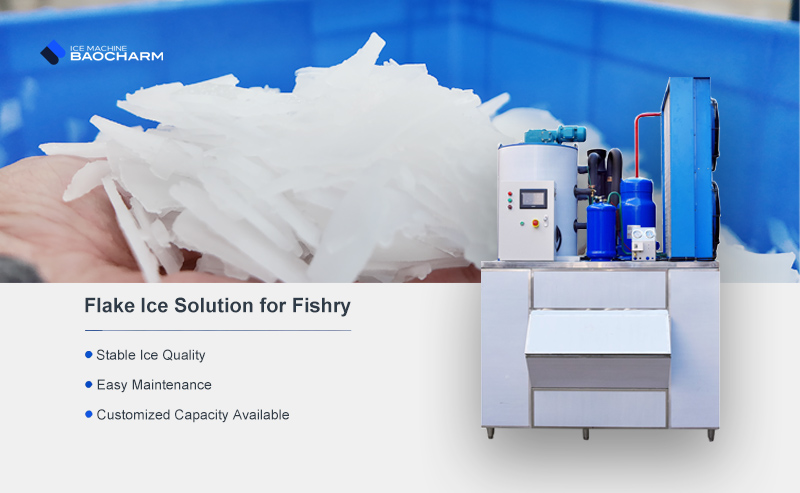
Manufacturers rate flake ice machines at defined conditions. AHRI ice harvest rate uses 32°C ambient and 21°C inlet water as typical rating conditions, while laboratory ratings may use 21°C ambient and 10°C inlet water. BAOCHARM ratings commonly reference 32°C ambient and 20°C inlet water. These conditions make capacity comparable across models. They do not describe your plant.
At higher ambient temperature, the condenser must reject more heat, and compressor duty rises. At warmer inlet water temperature, the machine must remove more sensible heat before freezing begins. Both effects reduce delivered ice output even when the refrigeration system is functioning correctly. Air-cooled machines in poorly ventilated rooms are especially sensitive: recirculated hot air can cut daily output by 20–30%.
Start with the maximum ice draw in a 24-hour period, not the monthly average. For seafood landing, peak demand often coincides with vessel arrivals. For concrete batching, peak demand follows the pour schedule. For chemical reactors, demand may be batch-driven and concentrated within a shift.
Two numbers are needed:
The second number determines whether storage and delivery can bridge between machine output and process draw. A machine that matches daily tonnage but cannot deliver at peak hour will underperform in practice.
Apply a correction factor based on your actual ambient and inlet water temperatures. If the manufacturer publishes output at both laboratory and hot-day conditions, use the hot-day figure as the starting point. If a single rating is published, apply a derating consistent with industry guidance: 15–20% margin as a starting point, and 25–30% derating in hot back-of-house conditions before adding the peak margin.
| Scenario | Ambient (°C) | Inlet water (°C) | Rated output (t/day) | Estimated actual output (t/day) |
| Laboratory rating | 21 | 10 | 5 | Near nameplate |
| Typical rating | 32 | 21 | 5 | Nameplate reference |
| Hot site, air-cooled | 38 | 28 | 5 | Below nameplate; apply site correction |
| Hot site, water-cooled | 38 | 28 | 5 | Smaller correction than air-cooled |
Illustrative worksheet. Actual output depends on condenser type, ventilation, refrigerant charge and maintenance condition. Confirm with site data before purchase.
The correction is not a universal factor applied to every machine. It is a starting point that should be narrowed with the supplier using the actual installation conditions.
After correction, add a sizing margin. The margin covers day-to-day variation in ambient temperature, inlet water temperature, production interruptions and demand spikes. A 15–20% margin above the corrected requirement is a common starting point. In tropical sites or operations with limited maintenance access, a larger margin may be justified.
Then check storage. Insulated storage is commonly sized to hold roughly one-third to one-half of daily production. The right number depends on the draw-off curve: if ice is taken evenly across the day, a smaller buffer may suffice; if draw is concentrated in a few hours, a larger buffer is needed.
| Daily demand (t) | Peak hourly draw | Suggested storage buffer | Sizing note |
| 5 | Moderate, spread across shift | Roughly 1/3 of daily production | Confirm with draw-off curve |
| 10 | Concentrated in a few hours | Roughly 1/2 of daily production | Buffer may need to be larger if draw is abrupt |
| 20 | High peak, short window | Sized to bridge peak window | Storage and delivery rate both matter |
Storage sizing is project-specific. The table illustrates the logic, not a fixed rule.
Capacity calculation does not replace a water-quality assessment or a site ventilation review. Hard water accelerates scale on the evaporator drum, which reduces heat transfer and can make flakes soft over time. Poor condenser ventilation has the same effect as high ambient temperature. These factors should be addressed in the installation design, not compensated for by buying a larger machine.
The working principle behind capacity response is covered in How a Flake Ice Machine Works: Vertical Inner-Scraping Evaporator and Ice Blade Explained; the selection consequences are covered in the pillar guide Industrial Flake Ice Machine Selection and Buying Guide: From Ice Type to Full-System Fit.
Why does flake ice output drop in summer?
Higher ambient temperature increases the condenser’s heat-rejection burden, and warmer inlet water requires more heat removal before freezing. Air-cooled machines in hot, poorly ventilated rooms are most affected. The drop is a refrigeration-load effect, not necessarily a fault.
How much sizing margin should I add?
A 15–20% margin above the corrected requirement is a common starting point. In hot back-of-house conditions, a 25–30% derating may be applied before the peak margin is added. The right margin depends on site temperature, ventilation and maintenance access.
How do I calculate peak ice demand?
Peak demand is the highest ice draw in a 24-hour period, plus the highest hourly draw rate. The daily figure sizes the machine; the hourly figure sizes storage and delivery. Both are needed to avoid a system that produces enough ice but cannot deliver it when the process draws.
Get a corrected capacity estimate. Send your daily requirement, peak hourly draw, ambient temperature and inlet water temperature for a summer-adjusted output calculation. → Get a capacity estimate


Nossos contatos
E-mail: sales@baocharm.com
WhatsApp: +86 17663537579
WeChat: +86 17663537579
Horário de funcionamento: Seg. a Sáb., das 8h30 às 17h30.
 Suporte a redes IPv6

